
Orthopedic surgical robots and 3D C-arms are both critical technologies in modern orthopedic surgery. While the robot provides precise navigation, the 3D C-arm offers intraoperative imaging guidance. As the use of robotic navigation systems becomes more common, their coordinated application has proven essential in improving surgical efficiency and safety.
But does this mean orthopedic robots and 3D C-arms must be from the same brand? What are the advantages of doing so?
The short answer: No, they don’t have to be the same brand—as long as interface compatibility is ensured.
1. Interface Compatibility Determines Integration
The synergy between an orthopedic robot and a 3D C-arm depends on accurate data exchange and image registration. Some manufacturers offer open interfaces, allowing cross-brand integration through standardized protocols such as DICOM and HL7. For example, Medtronic’s Mazor X robotic system can be used with third-party imaging devices, integrating multi-source imaging through its navigation platform. This openness gives hospitals greater flexibility in equipment selection but may require additional calibration to ensure registration accuracy and can increase system setup complexity.

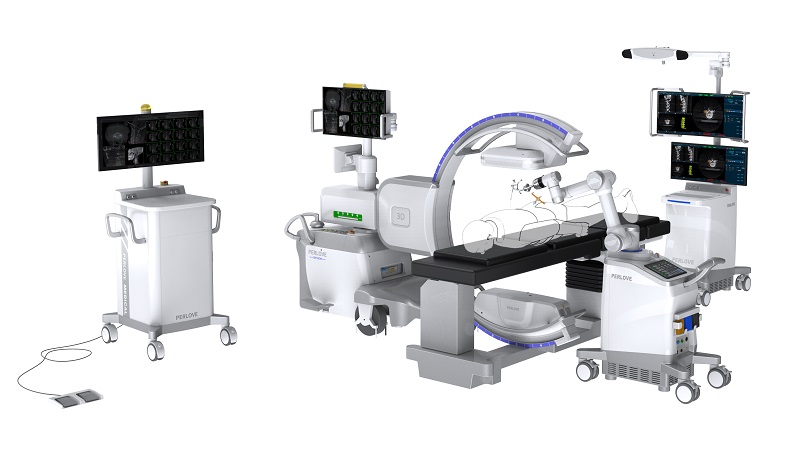
On the other hand, some manufacturers adopt a “single-platform solution,” where both the robot and 3D C-arm come from the same brand, enabling seamless communication and system integration. For instance, the PL300B orthopedic surgical robot and PLX C7600 3D C-arm by Chinese manufacturer Perlove Medical are designed to work together using integrated 3D trajectory registration. This allows for automatic registration and real-time image guidance without manual adjustments. The system achieves a high registration accuracy of ≤0.7mm (source: National Testing Report No. [2021]1273), making it suitable for complex spine surgeries that demand extreme precision.
2. Advantages of Using the Same Brand
In clinical settings, the choice of equipment is influenced by surgical requirements and hospital size. For high-precision procedures such as spinal surgeries, same-brand combinations offer clear benefits. For example, Zhongshan Hospital in Shanghai uses Perlove’s robotic system and 3D C-arm during pedicle screw fixation procedures. The integrated system enables real-time 3D imaging and navigation feedback, achieving millimeter-level screw placement accuracy. This “closed-loop system” minimizes compatibility-related errors and delays, especially critical in anatomically complex regions like the thoracolumbar spine.
Procurement and maintenance are also key considerations for hospitals. Choosing devices from the same brand can streamline purchasing, reduce system integration costs, and simplify after-sales support. Perlove Medical, for instance, offers a comprehensive “3D C-arm + orthopedic surgical robot” solution, helping hospitals accelerate the bidding process and ensure consistent support.
3. Final Thoughts
Ultimately, the decision should be based on clinical needs, cost-benefit analysis, and long-term planning. For high-precision spinal surgery or large tertiary hospitals, opting for same-brand systems maximizes compatibility and performance. In contrast, for procedures like joint replacement or in medium-sized hospitals, cross-brand combinations can still meet clinical needs—provided they are thoroughly tested and validated for registration accuracy and workflow efficiency.
If a hospital already owns a 3D C-arm, it should evaluate its compatibility with new robotic systems before procurement to avoid unnecessary or incompatible purchases.


